Epoxy juvenile sandlance
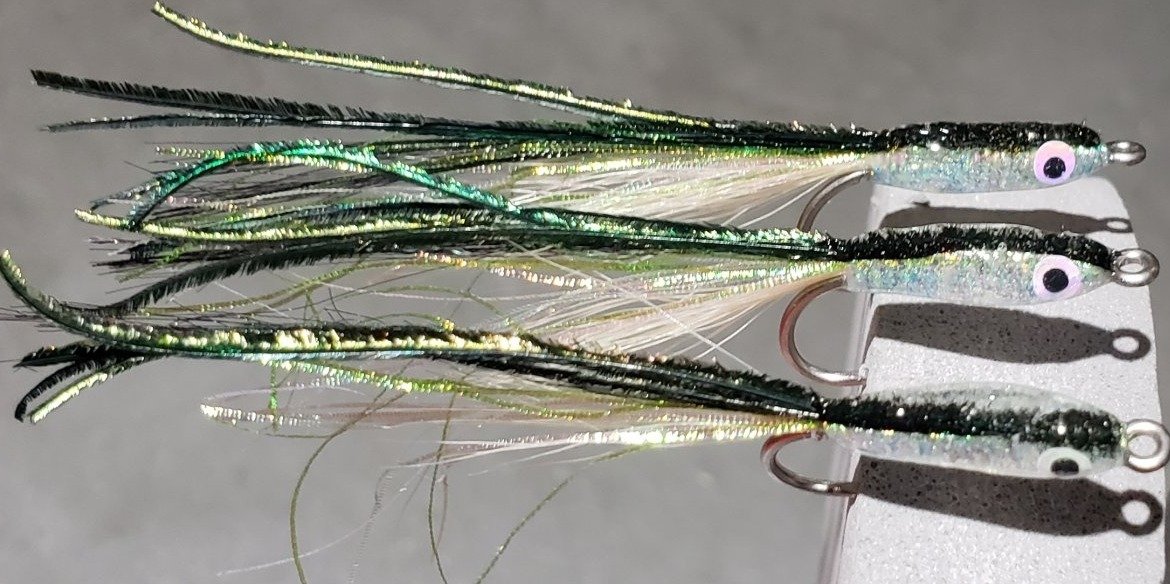
By DimeBrite variation of similar pattern in Fly Fishing for Pacific Salmon II, submitted by DimeBrite.
Description
This pattern is very durable and doesn't foul easily. Salmon attack the head, so the tail can be lengthened to match the sandlace population. The fly makes a nice splash after casting and is often grabbed immediately if a salmon is on the area. Strip erratically: fast, slow, twitch-twitch, pause, long strip until a salmon inhales it. Use whenever you see schools of juvenile sandlance being attacked on shallow sandy beaches with eelgrass.
Tying Process
Wrap 8 turns 0.025 lead free wire onto shank near the eye. Form a body with silver mylar braid. Tie in a tapered clump of polar bear (white) for the base of the tail. Tie in Gliss-n-Glo mother of pearl (5 strands), then Gliss-n-Glo green or root beer (5 strands) for middle of tail. Tie in flash-a-bou mother of pearl (6 strands) and wrap up length of the shank to form a shiny multi-colored body. Tie in 4 peacock herl along top of the body extending back to form the top of the tail. Attach 2 small stick on baitfish eyes. Epoxy the body tail to eye of hook (5 minute epoxy) and place on a fly rotator. Wipe hardened epoxy body with isopropyl alcohol cloth, then coat with Sally Hansen Hard as Hull.
Materials
- Thread: Clear mono thread (thin)
Hooks
- Umpqua TMC811S size 4 or 2
Target species: Black Rockfish, Bull Trout, Chinook Salmon, Coastal Cutthroat, Coho Salmon, Dolly Varden
Fly types: Salmon/Steelhead, Saltwater, Streamer