Humpy 2.0 a.k.a. Moose Humpy — Humpy or Goofus Bug
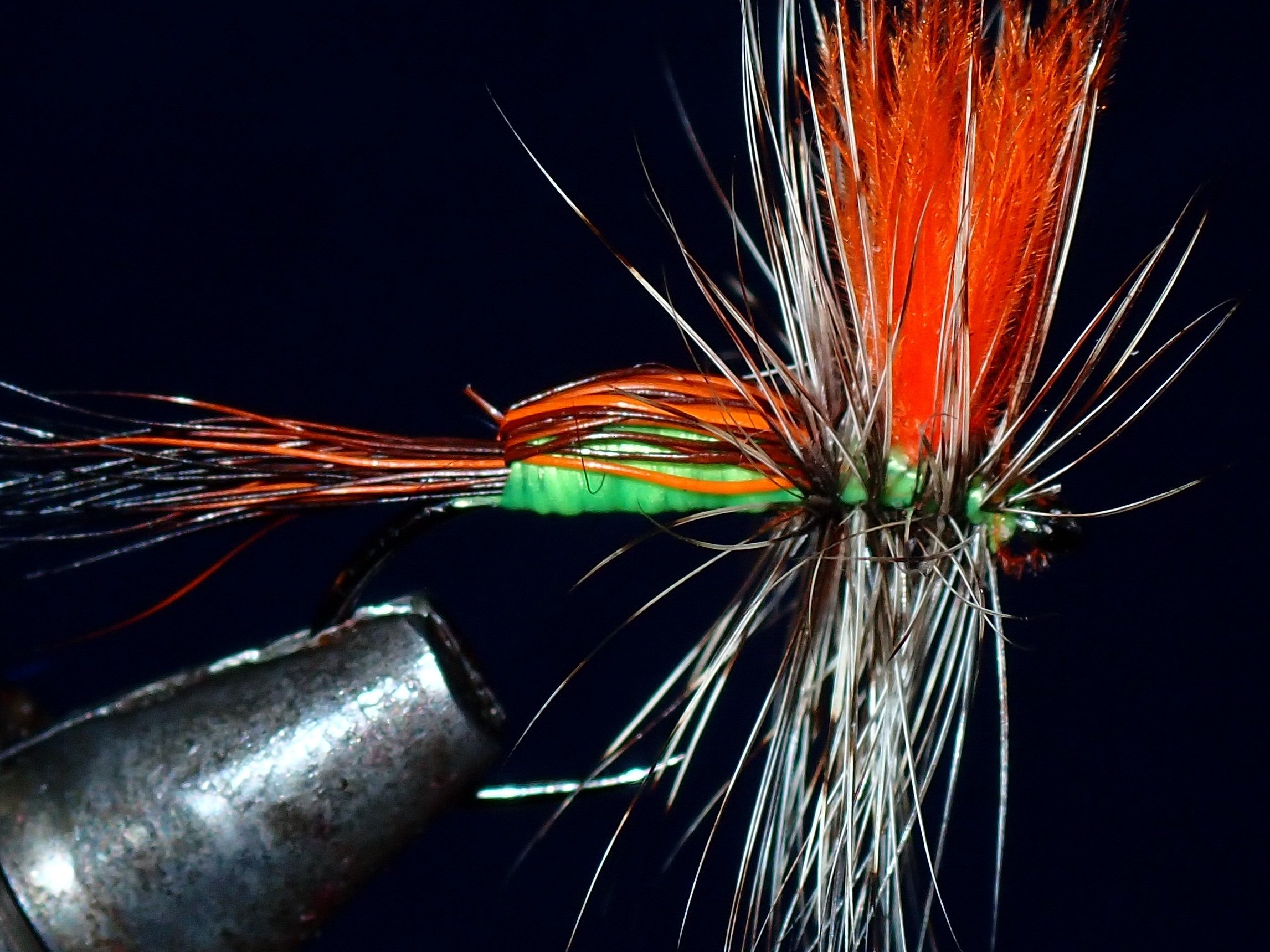
By Jack Horner, 1940s, submitted by Mike Cline.
Description
The Humpy as we know it today evolved from a deer hair bodied fly named: Tom Thumb created in the early 20th Century. By the 1940s a derivative fly, the Goofus Bug had been created by California angler Jack Horner for high gradient streams of the Sierras. Didn’t take long for the fly to catch on in the Northern Rockies and was soon aptly named “Humpy”, a high floating, robust deer hair dry fly excellent for fast water situations. Although it still is a popular pattern today, it is not one of the easiest flies to tie. Using deer body hair for the tail and a separate clump of deer hair for the over body folded over a floss underbody and deer hair wing can be a bit challenging and tedious. Watch any tying video on Humpies and you’ll see what I mean. However, a variation using a single clump of long moose body hair instead of two clumps of shorter deer hair and using the thread for the underbody instead of floss significantly simplifies the tying process—Humpy 2.0 a.k.a Moose Humpy.
Tying Process
Tying the Moose Humpy begins with laying a thread base starting at a point approximately 1/3 of the hook shank behind the hook eye back to the hook bend. A small clump of long moose body hair is stacked to align the tips. While ensuring the clump remains on top of the hook shank the hair is tied in at the hook bend to create the desired length of tail and thread wrapped forward over the hair to the 1/3 point behind the hook eye. The long moose hair is then folded tightly back along the hook shank and wrapped with thread back to the hook bend. Thread is wrapped around the moose hair to completely cover all the hair. This forms the underbody of the fly. The moose hair extending beyond the hook bend is then folded forward over the thread underbody, pulled tight and secured with two loose wraps to ensure in remains on top of the underbody. Additional tight wraps are made to secure the moose body in position and the hair ends trimmed close. A small dab of head cement on the hair ends finishes the body. Wings and hackle are added as desired in the front 1/3 of the hook shank.
Materials
- Body: Moose Body Hair, UTC 140 thread
- Hackle: Dry fly hackle
- Thread: UTC 140
- Wing: CDC Oiler puffs, Calf Hair, Deer Hair or Synthetic
Hooks
- Firehole 419, Dry Fly barbless #8 -#16
Target species: Trout
Fly types: Dry Fly